Tuesday, January 12, 2016
My Author Site Has Moved!
I created a more professional site at http://davidjnix.com. I will leave this one up for a while for historical reasons. Feel free to cruise the new site!

Sunday, September 27, 2015
Well Done: The Third and Final "Well" Installment
After a summer hiatus, I began work on the third and final installment of "The Well" series. "Started" is perhaps the wrong word, though. I actually wrote the final chapter of the series shortly after finishing the first installment, and everything else has been leading toward that specific conclusion.
As you may have guessed by the plot of "The Well", I enjoy a good twist. I may have saved the best for last, but that is for others to judge, not me. If all goes according to schedule, I should release the last installment around the end of October. My regards to Arthur C. Clarke, Agatha Christie, and others who raise the literary twist to an art form. You blaze a trail that few can follow but that many may aspire to!
As you may have guessed by the plot of "The Well", I enjoy a good twist. I may have saved the best for last, but that is for others to judge, not me. If all goes according to schedule, I should release the last installment around the end of October. My regards to Arthur C. Clarke, Agatha Christie, and others who raise the literary twist to an art form. You blaze a trail that few can follow but that many may aspire to!
Sunday, April 26, 2015
The Well 2: Falling - Now Available on Amazon
After escaping the Well, the underground bunker that has
sheltered his people for fifteen generations from the horrors of Surface,
Singer and his three cohorts find themselves falling from the frying pan and
into the fire! The world outside the Well could not be more hostile – a place
of barren desolation and airless death. However, the blue and white orb hanging
in a black sky beckons them toward the true path to Surface.

The escapees promptly run afoul of others that occupy the desolation, and land in confinement with death or return to the Well as the only viable options. Faced with the puzzle of finding a third option – one that takes him to Surface – Singer works to keep his small crew alive long enough to convince his captors to spare them. When the moment of epiphany occurs, Singer’s existence becomes more endangered still, for it requires a return to the Well – which has descended into madness. Even success of his plan may not save his life, let alone take him to mythical Surface. And even a journey to Surface to face the menacing mystery of The Darkness may result in certain death!
The escapees promptly run afoul of others that occupy the desolation, and land in confinement with death or return to the Well as the only viable options. Faced with the puzzle of finding a third option – one that takes him to Surface – Singer works to keep his small crew alive long enough to convince his captors to spare them. When the moment of epiphany occurs, Singer’s existence becomes more endangered still, for it requires a return to the Well – which has descended into madness. Even success of his plan may not save his life, let alone take him to mythical Surface. And even a journey to Surface to face the menacing mystery of The Darkness may result in certain death!
Wednesday, April 22, 2015
Sequel to "The Well" Is Nearly Done
My recent novella, The Well, works as a standalone story given the little slap-your-face twist at the end. Some of my favorite sci-fi short-story writers employed this strategy on a regular basis: give a story a twist ending that does not really settle the story but does make you think. This approach can annoy, I know. But it also provides a jumping off point for personal imagination. Thank you, Arthur C. Clarke, Gordon R. Dickson, et. al.
That said, The Well begs for more telling, and I intended to expand the story from the beginning. The second as yet untitled novella is nearly done, pending final copy edits and a cover. Oh, yeah - and a title. There is always the pesky nuisance of thinking of an appropriate title, which is often more difficult than it should be.
Anyway, the sequel is coming, and a third installment will wrap up the story. All is Well. Stay. Tuned.
Thursday, January 15, 2015
The Well - Now Available on Amazon
Fifteen generations before, the horror of Surface chased
Singer’s desperate ancestors into the vast underground bunker of the Well. In a
moment of darkest despair, Singer unsuccessfully attempts to breach the
long-obstructed hatch that leads outside – to certain death, as everyone knows!
In punishment, he is cast down from the most privileged level of Seven into the
hell of the Well’s lowest layer – the damp, crowded, and stinking Pit. Despite
the bleak turn of events, Singer’s harsh new surroundings begin opening his
eyes to the truth of the Well and of humanity, his revelations helped along by
the wise old Tech and his too-forward, too-unconventional, too-maddening
daughter.

Resigned to his prison far from Seven, Singer’s hope
rekindles with the discovery of a means to climb the central shaft that leads
back to Seven – and to the outer hatch. He joins uneasily with the Tech’s
daughter in a lunatic plan to ascend the shaft and escape the Well. But can
they dare hope to succeed? And if so, will they find a livable world outside on
Surface? Or will the terror that propelled their ancestors underground have the
final laugh? These questions seem unanswerable, for no resident of the Well is
equipped to imagine what lies above … especially not Singer!
Friday, November 7, 2014
Ugly Girl: Now Available on Amazon and Createspace
After an experiment with a different title and cover, I re-published Ugly Girl with the original cover art created for me by Mark Bulahao. Chalk it up to an exercise of over-thinking marketing. The original title of "Ugly Girl" perfectly captures the tone of the novel, so now it returns!
Also, I chose to market the novel for 99 cents - a departure from my $2.99 strategy with Shore of Monsters. There is much debate about the pricing of a novel, and the belief that 99 cent pricing places a novel into a category of "buyer beware" or "it stinks". There is a certain truth to that logic. The majority of 99 cent novels suffer significantly when compared to professionally published novels in many areas: cheesy covers, poor writing, poor story flow, significant editing mistakes, and general unprofessional presentation all around.
However. However. However.
I notice that very well-written, well-edited, well-packaged stories with compelling plot flow tend to sell, and some sell incredibly well. I would like to think that my novel fits those criteria, but I am the least objective consumer at this point. That said, no guts, no glory. My interest is in having as many readers of the novel as possible, whether the copy be free or 99 cents. Volume readership!
Monday, August 11, 2014
New Story: The Climb
After a hiatus from writing to re-consider my hobby, I started again with what I love: post-apocalyptic fiction. "The Climb" takes place in a world that should be readily recognizable as post-apocalyptic or at least dystopian. I don't believe the story will reach novel length, so I plan to offer it for 99 cents as an e-book. So fans of the post-apocalypse - here is the first page. See what you think!
The Climb
The Climb
In a moment of simple clarity, Singer left behind the
recently deceased bodies of his wife and newborn son and set out across the
fields toward the walls of the world. A primeval desire to move, to escape the
despair, drove him mechanically forward. And “out” seemed the best place to go,
despite the inevitable horror crouching there. The sleeping community of Seven
failed to notice his run, each person caught as they were in a personal clash
of dreams, nightmares, and the oblivion of slumber.
Within minutes, the mangled barricade obstructing the
hatchworks emerged from the opaque gloom of nighttime. Singer hesitated
briefly, scanning the arc of the stony wall for a patrol. No movement stirred
the edges of the world.
“Yoshida.” Singer mumbled the name of his old friend,
because tonight was his turn in the rotation. More than likely, the man was on
the other side of the great circle of Seven, studying his letters under the dim
lamp that continuously illuminated the stairwell entrance. Or stealing a
forbidden moment with someone else’s wife. Regardless, the barricade stood
unwatched.
A final glance across the fields, and Singer slipped
into the twisted metal of the barricade. Clambering over, under, and through
often-jagged obstructions, the man traced the path he and Yoshida had
discovered as boys still young enough to slip away without notice or
consequences. His labored breathing marked time – perhaps a few minutes –
before he slipped beneath a rusting beam to emerge into a clearing. The
hatchworks stood before him, still untouched for many lifetimes. Even he had
never dared reach out his hand. Until now.
Thursday, March 20, 2014
"Catch Me Falling" Advances in ABNA 2014
Another year, another Amazon Breakthrough Novel Award entry, this time with Catch Me Falling. The novel made the first cut and is on to the second round. This marks the third year in a row that I managed to get a novel through the pitch stage, but the previous entries did not advance to the quarterfinals. The quarterfinal round judging considers only the first 5000 words (15 - 20 pages). To make the next cut, the story must be attention-grabbing and very well written - particularly as compared to many other well-written entries. This year's submission is my best work in terms of tone, so I'm hoping that might be enough to move it along. Fingers crossed!
Saturday, March 8, 2014
Independent Publishing: Getting the Cover Right
I love my cover for Catch Me Falling, an original commissioned work of art from Mark Bulahao. It captures the poignancy of the story perfectly. See for yourself, and tell me the picture does pique a sense of wistful sadness within you.

However, there is always a however. I typically dislike howevers. However ... I received feedback from two unrelated sources that the cover was not reflective of the novel's genre and target audience. One response was, "lovely cover, and intriguing, but looks like a novel from the 70's or 80's." The other comment was similar, but not as friendly. Hurtful words, indeed. But after careful consideration, I found that I could not vigorously disagree. My emotional push back to the comments peaked at pathetic. So, back to the drawing board. Literally.
Based on a Wattpad experience of posting the first portion of the story, I know that the market for this novel are females under the age of thirty and over the age of fifty. Strange, I know, but the vast majority of the thirty fans of the Wattpad excerpt fell into those two categories. A little research told me that the first group (under-thirty women) are looking for bodice-ripper romance in imaginative forms - paranormal, fantasy, sci-fi, etc. The second group craves the same, but in gentler forms, as if seen through the lens of nostalgic memory. Covers for such novels have certain hallmarks, including:
- A woman and a man with obscured or semi-obscured faces
- Photo realistic renderings of the woman and man (not drawings)
- Hot guys with bare chests
- Women ignoring said hot guys, or playing hard-to-get
- Women physically assaulting said hot guys with lips, arms, and legs
- Visible emotional or sexual tension between the two
Tuesday, January 28, 2014
Titling A Novel: What's in a Name?
The hardest part of any given activity is not always what you predict before starting. The hardest part of riding a bike? The pavement, as you smack into it repeatedly. The hardest part of climbing a mountain? Coming back down, because you can't see your feet and your knees have ceased to function. The hardest part about rasing children? Uh, never mind. That's all hard.
When I began writing, I never imagined the degree of difficulty in titling my novels. I just wrote 80,000 words. A few works of title should be a piece of cake, right? Not so much, it seems. When writing, I typically have a working title. Only once has the working title stuck all the way through publication ("The Shore of Monsters"). In every other case, I spent a ridiculous amount of time inventing and discarding candidate titles. Having gone through this process for a whopping four novels and two study guides, I am far from expert. However, my awareness of the challenges has grown, and my understanding of strategy has increased. A little. Below is a list of my hard-earned wisdom to date. Which isn't much. But whatever.
- Good titles concisely capture the primary content. Better titles capture the tone as well. Case in point: The Road by Cormac McCarthy. He could have used a more descriptive title, but he opted for short and sweet. On the short-and-sweet front, he opted to use a loaded word in "road". That word implies many things: a journey, a destination, a challenge, a grind, a way out. The use of a word with so many implications to the general readership allows him to speak volumes about the nature and tone of the novel with a two-word title. Another example is Brave New World by Aldous Huxley. The title implies a tone of gung-ho upbeatness. However, the reader quickly realizes that the title is a satire of the content, which describes a new world that is anything but brave or desirable. In general, you should consider using loaded words or terms, or words that evoke strong emotion.
- Good titles are meaningful to the reader. Better titles are meaningful to readers of the target genre. For example, if you hear the title with the word "Sword" in it? Without knowing the content of the novel, what would you say the genre is? Fantasy? Historical Fiction? Probably. And you certainly wouldn't think is was primarily a romance novel. The first two elements that capture a reader's attention are the cover and the title. If your title strays too far from what is normal for your genre, it may not get a second look. You should be familiar with the use of titles within your target genre, and make some attempt to fit the mold.
- Good titles sound good when spoken. Better titles stick in the brain. For example, every one of John Green's titles. The Fault in Our Stars. Looking for Alaska. An Abundance of Katherines. All of these titles flow when spoken. All are intriguing enough to stick in the brain. And ultimately, all describe the content very concisely using loaded or emotional words that appeal to his young adult audience.
Yep. Developing a title can be very difficult. And in the end, there is no magic formula, only rules of thumb and things to consider. After all, the title of Moby Dick didn't hold it back.
Thursday, January 23, 2014
Cage of Skin and Bone: Published (as "Catch Me Falling")
After a lengthy delay, I decided to self-publish Cage of Skin and Bone. But not before changing the title to Catch Me Falling. I think it fits better with the story's primary category of "romantic fantasy".
In the past year, I more than satisfied my rejection quota as agent after agent either said "No, thanks" or did not bother to respond. Sure, I get that there are umpty-million aspiring authors and about thirty-seven agents. I understand that many fine stories never see the light of day through traditional publishing as a result. And I realize that self-publishing confines a novel to a life of limited upside. Yah, I get it. But dang it, I like this story, and would rather a few hundred people read it than none. So this is me shaking my fist at the universe once again and flinging my story into the readership void.
The 300-page novel is available on amazon.com, smashwords.com, itunes, nook, createspace, and a number of other outlets. Now begins the long, trudging march of marketing and selling it. Here. We. Go.
Wednesday, July 17, 2013
Cage of Skin and Bone: Change of Plans
At the strong advisement of two folks whose literary opinions I greatly respect, I have been contacting publishing houses for interest in taking on the novel as a publishing project. No luck yet. Going in without an agent is about like crossing Cuba without a boat: I'm in for a tough swim.

Still, success is remotely possible, especially with smaller publishing houses who still consider quality over mass appeal. The difficulty with contacting publishers is this: most frown upon simultaneous submissions, take longer to respond to submissions than do agents, and often do not respond at all. The result is a slow process that threatens to break my will.

Because I don't know how long this process will take before a) success, or b) raging impatience, I have started on the sequel to Cage of Skin and Bone. Nothing like writing to take my mind off of ... err ... um ... writing.

Still, success is remotely possible, especially with smaller publishing houses who still consider quality over mass appeal. The difficulty with contacting publishers is this: most frown upon simultaneous submissions, take longer to respond to submissions than do agents, and often do not respond at all. The result is a slow process that threatens to break my will.
Because I don't know how long this process will take before a) success, or b) raging impatience, I have started on the sequel to Cage of Skin and Bone. Nothing like writing to take my mind off of ... err ... um ... writing.
Friday, June 7, 2013
Going Forward with Publication: Cage of Skin and Bone
In early January I promised a valiant effort to find representation for the novel Cage of Skin and Bone. Today I reached the 5 month mark of that attempt after having contacted 21 prospective agents. Three agents requested part or all of the manuscript before politely declining. Eight more declined the query outright, again very politely. Ten never responded. The response / no response split is typical of what I've encountered before.
Let me just say this: I very much appreciate those who took the time to respond. I know agents are slammed by a million queries on top of the time they must spend serving their existing client base, so anyone taking the time to respond, no matter how briefly, has my undying respect!
Anyway, having exhausted my pool of patience for this particular work, I am proceeding with self-publication. The last round of copy editing is nearly complete and the cover is ready to go. Expect to see the novel in publication by the end of June.
 One positive side effect of the five month hiatus is the time it provided me to outline the rest of the series. Crissa's story will go on! For three novels, anyway. A mammoth undertaking, but I am ready! (A mammoth undertaking ... get it? Mammoth? Undertaking? And with the image of a mammoth? You see how I did that? Pretty clever, huh!)
Let me just say this: I very much appreciate those who took the time to respond. I know agents are slammed by a million queries on top of the time they must spend serving their existing client base, so anyone taking the time to respond, no matter how briefly, has my undying respect!
Anyway, having exhausted my pool of patience for this particular work, I am proceeding with self-publication. The last round of copy editing is nearly complete and the cover is ready to go. Expect to see the novel in publication by the end of June.
One positive side effect of the five month hiatus is the time it provided me to outline the rest of the series. Crissa's story will go on! For three novels, anyway. A mammoth undertaking, but I am ready! (A mammoth undertaking ... get it? Mammoth? Undertaking? And with the image of a mammoth? You see how I did that? Pretty clever, huh!)Saturday, March 23, 2013
The Run is Over for Cage of Skin and Bone
Alas, my new novel failed to advance to the quarter-final round of the Amazon Breakthrough Novel Award contest. I can only assume that the judges lost my entry. How else could you explain the lack of inclusion?
Actually, I'm certain that the remaining novels are mind-numbing miracles of literature and worthy of advancement. In the meantime I take heart in history. Einstein's theories were originally mocked, President Truman failed at business, and Edison made one thousand failed light bulb designs before inventing one that worked. And Jennifer Hudson did not win American Idol, for crying out loud. You go, girl!
Back to the old pen and inkwell!
Thursday, February 14, 2013
On to Round 2 of ABNA 2013: Cage of Skin and Bone
Cage of Skin and Bone has advanced to round 2 of the Amazon Breakthrough Novel Award 2013 contest. What does that mean? It means that I'm the second coming of Charles Dickens and Jane Austen all rolled into one. No? Actually, it means that my pitch was good enough to merit a further read from the judges. That's all.
Four-hundred novels in the young adult category advanced to Round 2. In this round, judges will read 3000 - 5000 word excerpts for each entry, and identify the 100 that will advance to the quarterfinal round. My submission last year, The Shore of Monsters, also advanced to the second round, but did not make the quarterfinal round. I'm hoping for a better result, but, hey - every novel is a longshot at this point.
Four-hundred novels in the young adult category advanced to Round 2. In this round, judges will read 3000 - 5000 word excerpts for each entry, and identify the 100 that will advance to the quarterfinal round. My submission last year, The Shore of Monsters, also advanced to the second round, but did not make the quarterfinal round. I'm hoping for a better result, but, hey - every novel is a longshot at this point.
Tuesday, February 12, 2013
The Shore of Monsters Duology: Re-Released
I finished overhauling The Shore of Monsters and its sequel, Fall of Darkness, and posted both to multiple e-book sites. By converting the story from third-person to first-person, I was able to expose more of the heroines observational nature. And, to reinforce the need for professional copyeditors, I found and fixed a number of mistakes. To meet Smashword's new resolution guidelines, I had to quickly assemble two new covers for that site only. Here they are, simple and not so subtle.


Friday, January 18, 2013
Self-Publishing: Producing Original Cover Art, an Example
My newest work, Cage of Skin and Bone, features original artwork. For my previous novels, I or a digital artist created covers by blending stock photos. This time I decided to step up the quality of my product. After trolling the internet for cover artists, I found a great source at deviantart.com. Tons of artists advertise their services, and offer samples of their work. While searching the site, I stumbled across the work of Mark Bulahao. His work in the fantasy/sci-fi area is stunning. Check out his work at his website:
Furnacehead: Mark Bulahao Art
Click on "Portfolio" at the upper left of the homepage to see what attracted my attention. I contacted him, and gave him the gist of my story as well as a basic idea of what I might like on the cover. From that he sketched two rough concept images:


The first shows the story's heroine, Crissa, in a cage with the wolf she raises. The second is more of a movie poster style rendering, showing Crissa, her nemesis Bayna, and a woolly mammoth (who feature heavily in the story). I was leaning toward the second concept, but upon seeing the sketches, was struck by the quiet poignancy of the first. We went ahead with that. Mark asked me what well-known person or actress might represent the "look" I had in mind. We settled on Elisha Cuthbert, seen below.

She's obviously gorgeous, but I did say that I didn't want the cover girl to appear too sexy. Mark re-sketched that one with Elisha in mind, and sent me this as a modified concept.

After some feedback, and a couple refinements of the concept, he produced the final spectacular cover art below.

Fantastic! Mark was great to work with, and I tried not to over-specify or nit-pick details. Given freedom to express his artistry, Mark produced a final cover that is far better than I anticipated, for an extremely reasonable price!
Furnacehead: Mark Bulahao Art
Click on "Portfolio" at the upper left of the homepage to see what attracted my attention. I contacted him, and gave him the gist of my story as well as a basic idea of what I might like on the cover. From that he sketched two rough concept images:

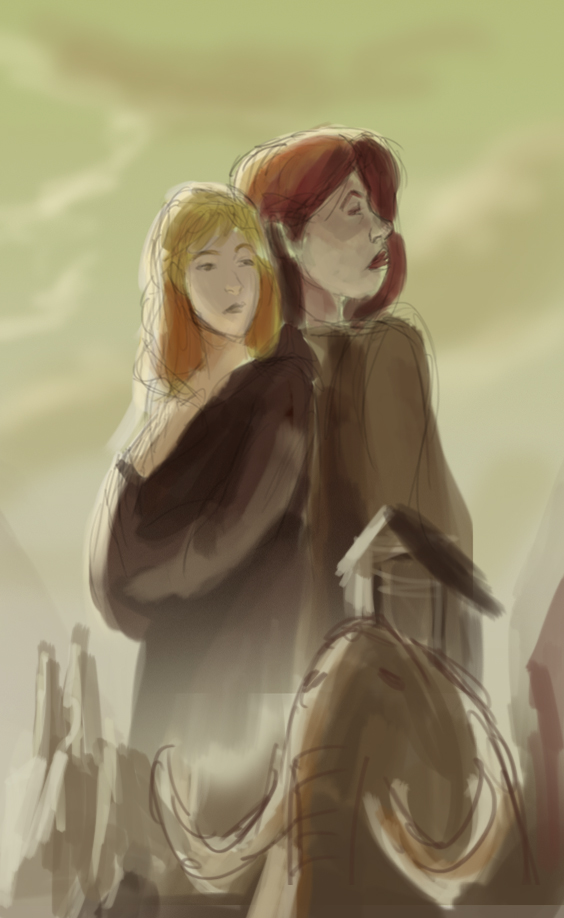
The first shows the story's heroine, Crissa, in a cage with the wolf she raises. The second is more of a movie poster style rendering, showing Crissa, her nemesis Bayna, and a woolly mammoth (who feature heavily in the story). I was leaning toward the second concept, but upon seeing the sketches, was struck by the quiet poignancy of the first. We went ahead with that. Mark asked me what well-known person or actress might represent the "look" I had in mind. We settled on Elisha Cuthbert, seen below.
She's obviously gorgeous, but I did say that I didn't want the cover girl to appear too sexy. Mark re-sketched that one with Elisha in mind, and sent me this as a modified concept.

After some feedback, and a couple refinements of the concept, he produced the final spectacular cover art below.

Fantastic! Mark was great to work with, and I tried not to over-specify or nit-pick details. Given freedom to express his artistry, Mark produced a final cover that is far better than I anticipated, for an extremely reasonable price!
Shore of Monsters Modification
I've about decided to modify Shore of Monsters and Fall of Darkness to render Sky's story in first-person. My decision is driven by a recent Wattpad experience that blew me away. I'll post more about that soon. Stunned, I am. How's that for a tease?
ABNA Pitch Observations and Advice
Last year I entered my novel The Shore of Monsters in ABNA 2012. I literally did it at the last minute. Starting on my pitch about 3 hours before submissions closed, I entered everything with about an hour to spare. Given that I didn't spend much time on my pitch, I wasn't very hopeful. However, my novel made it past the pitch stage to the next round. Beginner's luck!
This year, I actually read a number of example pitches from previous winners, found at the following link: ABNA Winning Pitches
I also read a couple of dozen others that advanced deep into the competition. Only then did I realize what I could have done earlier to improve the pitch, and what to do for this year's entry. In particular, I noticed three common threads regarding winning entries.
1. The first fifty words should grab the reviewer by the throat and shake vigorously. In fact, those first couple of lines should be so intriguing that the rest of the pitch is not necessary. Given that reviewers have hundreds of pitches to dig through, instead of reading each pitch and carefully considering it, they probably adopt the mind set of looking for reasons to discard a pitch. If the first few sentences don't knock the reviewer's socks off, then it's too easy for that person to discard it without even finishing. (By the way, anyone who has ever gone through a giant stack of resumes understands what I'm saying; you find yourself looking for resumes to exclude, not include. Human nature!)
2. The writing in the pitch must reflect the writer's work. I mean that on two levels. First, the pitch must scream "this writer can sling ink with the best of 'em!" If the writing in a pitch is mediocre, then say goodbye your dreams of the big prize. Second, the tone of the pitch should reflect the tone of the work. Humor, darkness, melancholy, quirkiness - whatever drives your novel should be present in the pitch, and in abundance.
3. You should summarize the work in general terms at the end of the pitch. In particular, you must find a way to communicate how you believe this work will attract and affect readers, and what they will take away from it. Most winning pitches include this part, and they are extremely well-worded at that.
Given those unofficial guidelines, I wrote the pitch below for my entry Cage of Skin and Bone. Keeping it to 300 words was challenging, but it did help me both tighten the verbiage and consider what plot elements were the most important.
For eighteen year old Crissa, life as a caged display in a traveling freak show has no upside. Unless she counts free room and board. People stare with disgusted curiosity, and say terrible things about her. How ugly she is. How strangely she behaves. And worst of all, how much she resembles the brutish Humans who died long ago. But they come by thousands to hear her do what no other can do. Sing!
In a ‘what-if’ world where prehistoric Humans fell extinct and Neanderthals inherited the earth, Crissa looks like no other. Imprisoned by the brutal Tal-Bern, who six years earlier murdered her mother and hauled her away, Crissa serves the glory of the circus. Every night she faces hostile crowds who marvel at her disturbing strangeness. And every night she stuns them with passionate singing, before returning to a dank cage. If not bad enough, her circumstances grow bleaker. She is marked for death, sold by Tal-Bern to the highest bidder for sacrifice during the bloodthirsty Rite of Long Moon – which is fast approaching. Though all seems lost, the shuttered window to her future opens when one evening she spies a young man in shadows beyond the crowd – and his face is like hers!
Freed by the stranger, she flees with him toward the vague promise of a better place. Backed by the ruthless man who wishes to sacrifice Crissa for a dark purpose, Tal-Bern pursues the two. Crissa’s headlong flight carries her toward the mysteries of a murky past, her Human face, and the wonderment of love and belonging. If only Tal-Bern doesn’t destroy her first.
Crissa’s observant narrative drives Cage of Skin and Bone in a story that explores the burden of exclusion, the power of kindness, and what it means to be human.
Update: This pitch made it past the pitch round at ABNA 2013. O joy!
Friday, January 4, 2013
How Do You Sell Self-Published Novels?
After entering the realm of independent self-publishing in late 2011, I focused my energies on selling my novels. Two problems:
(1) I had not a clue of what to do, and,
(2) I needed to spend time writing, and selling is very time consuming!
By Spring of 2012, I had three fiction novels in publication and one study guide (for the Great Gatsby). I managed to sell 400+ copies of those books over the course of the year. Four-hundred is an interesting number. It's not the thousands I'd like to sell, but it's also not the few dozen that many self-published authors report. The number was high enough to give me hope, and to allow me to learn some of what does and doesn't work.
So what did I learn? Here's a short list.
(1) Reviews matter. The more positive reviews I had for a novel, the more it sold.
(1a) Pay attention to the reviewer comments. They are solid gold. I learned more from a couple of critical reviews than I did from twenty positive ones. I appreciate readers who are honest enough to say "I liked it but ..." or even "Seriously?"
(2) Publish on multiple platforms, but focus on Amazon and Smashwords. I published on Amazon, Createspace (paperback), Smashwords, and Barnes and Noble. Seventy-five percent of my sales came from Amazon. Twenty percent came from Smashwords, who pushed my work to a dozen platforms that I couldn't do on my own without great difficulty (particularly Apple). Of those platforms, Apple sold the best.
(3) Be active on reader sites like Goodreads, Safari, Amazon, Yahoo Answers, Wattpad, etc. That includes having author profiles, participating in forums, and running promotions. Readers appreciate your active presence, and leave lots of helpful reviews. Goodreads alone boasts millions of readers. Yahoo Answers is a good forum for building a reputation as someone knowledgeable in your space, as long as you provide informative answers and don't try to pimp you books.
(4) Speaking of Wattpad, post your story there, particularly if you write YA. Teen readers are happy to tell you what they like (or don't like) through votes, fanning, and even comments. Wattpad has umpteen millions of readers and writers.
(5) Give away copies of your novel - the more the better. That includes Amazon (KDP Select) giveaways, and promotions on Goodreads. Probably one-third to one-half of my sales were generated in the week following giveaway promotions (I did several). I read one self-published author say "I'm not giving my novel away; it's too good for that." His comment was one of the dumbest things I've ever heard, and I've heard some dumb comments. The guy sold only a few copies of his novel last year. There are millions of readers in the U.S. alone. Even if he had given away 100,000 copies, he wouldn't have scratched the surface of potential readers, and his novel would have been famous. If I could give away a million copies of my novels, I would. My numbers tell me that one million giveaways would result in 50,000 to 100,000 sales. I can live with that!
(6) Publish multiple novels. One novel sale often generates another novel sale to the same reader.
(6a) Write in series, if it makes sense for your story. Readers who like your novel are somewhat likely to buy the second and third installment. That tactic is a bit difficult for me, because I prefer standalone novels to drawn-out, indefinite series. However, I did produce a two-volume series, and the follow-on effect was very evident.
(7) Editing matters. Mistakes, even a few, can depress the review rating a reader would have otherwise given you. It says, "I'm not a serious writer." Self-published authors can't often afford the $1200 or more to hire a competent copy editor. If that is the case for you, then give a copy to as many of your highly-literate friends as possible - other authors, your high school English teacher, your reclusive friend who reads two hundred novels a year, and the like.
(8) Blog about your area of expertise. It gives you credibility, connects you to readers, and increases your social network (i.e. potential readers of your work).
(9) Set your price either at 99 cents or $2.99. Don't mess around with anything else. A 99 cent novel can generate a larger number of sales because most readers are willing to risk 99 cents on a novel that might not be good. The $2.99 level is an Amazon-driven number. If you set your price at $2.99 on Amazon, you keep 70% of it (compared to 30% for 99-cent novels). That means one novel sale at $2.99 nets the same revenue to you as six or seven 99-cent sales. Use the 99-cent price to generate volume, and then switch to $2.99 when the sales are steady. There are lots of theories about "right-pricing" your novel. This is just my unscientific opinion, not "The Voice of God".
What should I do next year? Here are a few things I've learned from other authors and my experience.
(1) Get as many reviews as possible, especially from those who have a platform on which to share reviews with others. I tried a bit, but not nearly enough, to get professional reviews. I ended up with four reviewers promising to post a review at some point. However, they get megatons of requests for reviews, including requests from publishers. Going forward, I plan to ask for reviews from at least fifty reviewers per novel. Annie Oldham took this approach with her novel, The Burn. Lots of reviews, not all of them effusively positive. However, it got her novel noticed. As a result she enjoyed great sales, as extrapolated from her steady Amazon ranking.
(2) Create a larger social media footprint. I am limited primarily to blogging at this point. I haven't taken advantage of Twitter, Facebook, and other social media platforms to create a following. Nick Cole (The Old Man and the Wasteland) rose to the top of Amazon bestseller lists with help from his extensive media footprint.
(3) Work harder at my craft. A tiny fraction of authors sell more than a few hundred books per year. The number of sales is usually a direct result of effort. The more time I spend writing and marketing, the better I do. Simple.
(4) Find an agent to get my novel(s) into publication. It is hard to beat the marketing opportunities provided by a traditional publishing house. There are a few well-known self-published authors who describe traditional publishers as the devil, and insinuate that you would be stupid to go that route. These folks also tend to sell tens of thousands of copies per year, so it's easy for them to offer that advice. For the other 99.99% of us, publishing your novel through traditional means is a fantastic achievement.
Authors - what works for you?
Subscribe to:
Posts (Atom)